When a holiday costs hundreds or thousands of dollars, your time at the destination is too valuable to waste searching.
According to a British survey of 2,000 adults, preparing for a holiday takes an average of 19 hours per holiday. That time goes on more than booking flights and hotels: travellers search for activities, practical information and transport, while 53% are already making plans for the following day on the first day of their holiday.
How much time does it take to plan a holiday?
A British survey of 2,000 adults found that travellers spend an average of 19 hours preparing for their holiday. This includes searching for activities, making practical preparations, arranging insurance, budgeting and taking care of other matters before departure.
A more recent American study into group travel arrived at almost exactly the same figure. Participants in successful group trips reported spending an average of nearly 19 hours planning over 11 days. The research was conducted by Talker Research on behalf of Discover Puerto Rico among 2,000 American women.
That 19 hours does not mean that everyone spends exactly the same amount of time planning. A weekend away obviously requires less preparation than a three-week tour. However, the figure does show how much time can disappear around a holiday through searching, comparing and organising.
---
Where does those 19 hours of holiday planning go?
Planning a trip involves much more than booking transport and accommodation.
For example, the American study found that participants spent an average of 2.6 hours searching for things to do at their destination and 2.5 hours choosing the destination.
Then there are all the smaller questions:
- What can we do near our hotel?
- Which attractions are really worth visiting?
- What will we do if it rains tomorrow?
- Where can we park?
- How do we get from the airport to our hire car?
- Which restaurants are nearby?
- Which activities need to be booked in advance?
- What is interesting about the place where we are staying?
- Which local customs or scams should we know about?
None of these questions is particularly complicated on its own. It is mainly the cumulative effect that takes time.
----
How much time do travellers spend searching for travel information online?
The number of minutes quickly adds up online too.
Expedia Group and Luth Research investigated travellers' online behaviour in seven countries. In the 45 days before making a booking, travellers viewed an average of 141 pages of travel content and spent an average of 303 minutes — just over five hours — doing so.
This figure relates specifically to the period before booking and should therefore not be added to the 19 hours from the other studies.
It does, however, show the same pattern: digitally, a trip consists of a large number of small search moments.
Looking at a hotel. Reading reviews. Opening Google Maps. Comparing an activity. Returning to the hotel website. Looking up a restaurant. Checking once again how long the journey takes.
And not all those questions disappear after booking.
-----
Does travel planning stop once your holiday is booked?
No. Booking a trip does not automatically mean that the planning is finished.
For many travellers, their flights and accommodation are already fixed while the daily itinerary is still largely open.
Tripadvisor reported, for example, that around three-quarters of travellers who book activities do so before departure.
That means there is still a whole second planning phase between “the holiday is booked” and “we are leaving”:
What are we actually going to do there?
It is precisely during this phase that people search for attractions, walks, restaurants, excursions and other activities.
----
Do people also plan during their holiday?
Booking.com surveyed more than 18,000 travellers from 25 countries about their behaviour during the first 24 hours of their holiday.
53% said they planned activities for the following day on the first day of their holiday.
So even once the bags have been unpacked and the holiday has officially begun, many people start searching all over again.
- What shall we do tomorrow?
- Where shall we go?
- What is there to do nearby?
That makes sense. The weather changes. You discover new possibilities at the destination. Perhaps you no longer feel like driving for an hour, as you thought you would at home. Or you suddenly see a building and want to find out what it is.
A completely rigid itinerary is not desirable for most people either.
But there is a difference between travelling spontaneously and having to Google things repeatedly.
-----
Why does holiday planning take so much time?
Because travel information is spread across dozens of sources.
Your bookings are in emails and PDFs. The route is in Google Maps. You get the weather from a weather app. You search Google or Tripadvisor for activities. Restaurants are found somewhere else again. Exchange rates are in yet another app. And practical information about the destination can be found on websites, blogs or government services.
So the problem is not necessarily that there is too little information.
Quite the opposite.
There is simply an enormous amount of information, spread across an enormous number of places.
As a result, travellers have to search, filter and decide what is relevant at that moment over and over again.
----
Can a travel agency reduce this searching?
Yes, and that presents an interesting opportunity for travel agencies.
For a booked trip, a travel agency often already has much of the key context:
- destination;
- travel dates;
- hotels;
- flights;
- transfers;
- hire car;
- planned excursions.
Traditionally, travellers mainly receive this information in booking documents, vouchers, emails or an itinerary.
But the same data can also be used to support travellers more effectively during their trip.
Not by sending even more information, but by making the right information available at the right time.
----
How does TravelAppBuilder reduce searching during your trip?
TravelAppBuilder does not start with an empty map or a general list of tourist tips.
For each day of your trip, the app searches specifically for what may be relevant to do, visit or discover in your area.
Think of local attractions, special places, up-to-date suggestions and interesting stories about the surrounding area. This information is then linked to the day on which you are actually there.
As a result, you do not have to keep scouring different websites, blogs, maps and review platforms to decide what you want to do that day.
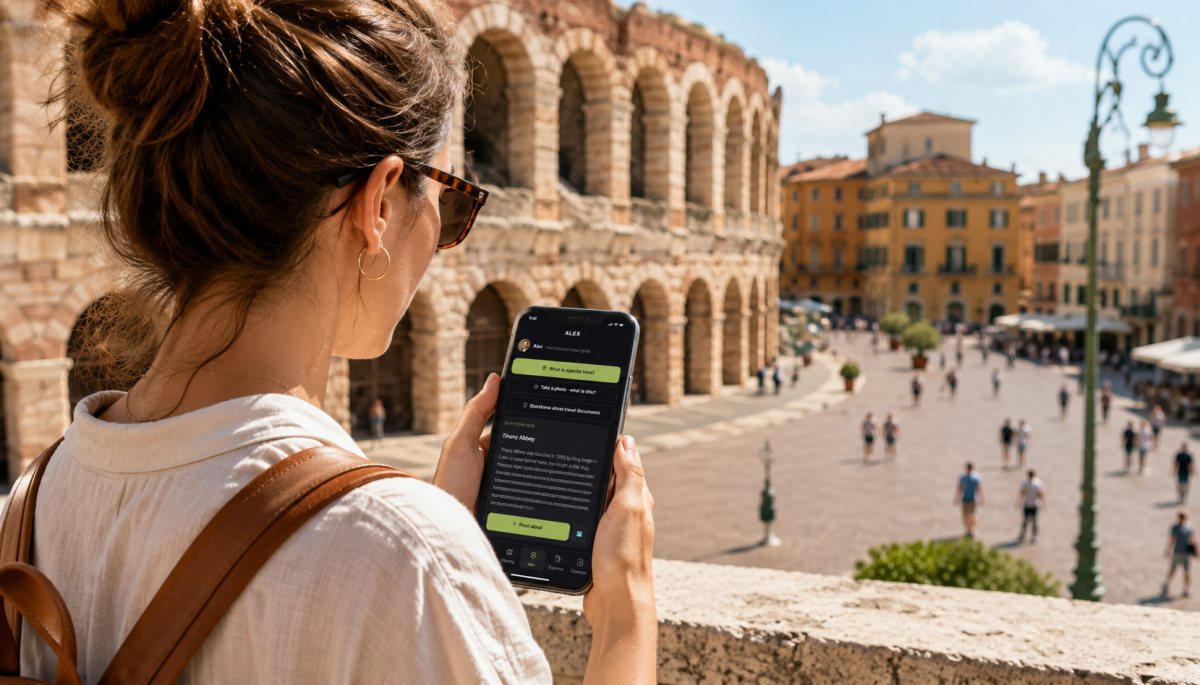
Alex goes one step further. The travel guide uses your location to show stories about the place where you are at that moment: important historical events, notable buildings and famous people who were born there, lived there or played a role there.
The difference is therefore not about offering even more information.
It is about finding, filtering and presenting relevant information when you need it.
The aim is not to schedule every holiday day down to the last detail.
Quite the opposite.
The aim is to spend less time searching and have more time to enjoy your trip.
----
So do you no longer need to prepare at all?
No. For some trips, preparation is part of the enjoyment. Many people like discovering restaurants in advance, planning routes or looking for unusual activities before they leave.
Technology does not have to take that away.
It can mainly reduce the repetitive work: searching for an address again, opening a booking email again, checking the weather for the next destination again or looking through twenty websites at the destination to find out what there is to see nearby.
The ideal travel app does not decide everything for you. It provides valuable suggestions
----
How much time can you save with a single travel app?
There is no independently measured figure for TravelAppBuilder yet. It would therefore be incorrect to claim that the app saves, for example, five or ten hours per holiday.
What research does clearly show is that travel planning takes up a significant amount of time:
19 hours
Average preparation time in a British survey of 2,000 travellers.
2.6 hours
Average time that participants in a recent American group travel survey spent solely researching what they could do at their destination.
303 minutes
Average time travellers in Expedia's research spent on travel content online in the 45 days before making a booking.
53%
Percentage of travellers in the Booking.com study who planned activities for the following day even on the first day of their holiday.
The studies measure different aspects and populations, so the figures should not be added together. Taken together, however, they show one clear pattern:
booking a holiday is not the same as being finished with the planning.
----
What is the ultimate aim?
Not to plan fewer trips because planning is bad.
But to spend less time looking for information that should really have been available already.
Your hotel is already booked. Your destination is known. Your travel dates are fixed.
During your holiday, you should not have to start searching from scratch every time.
Less searching. More holiday.
Sources: