...and which travel app is the best?
The “best travel app” does not exist – so what now?
Because three completely different products use the same name.
- Planners work before departure: you build the route, pin places and drag days around. Wanderlog, Lambus, Tripomatic and the AI planners.
- Travel companions work during the trip: they know which important historical events took place around you, which famous people grew up there, where you are staying that night and what the weather will be tomorrow.
- Travel journals work afterwards. Polarsteps.
Almost every disappointment comes from choosing the wrong category. A planner is not broken because it tells you nothing in the morning.
----
Which travel app helps you during the trip itself?
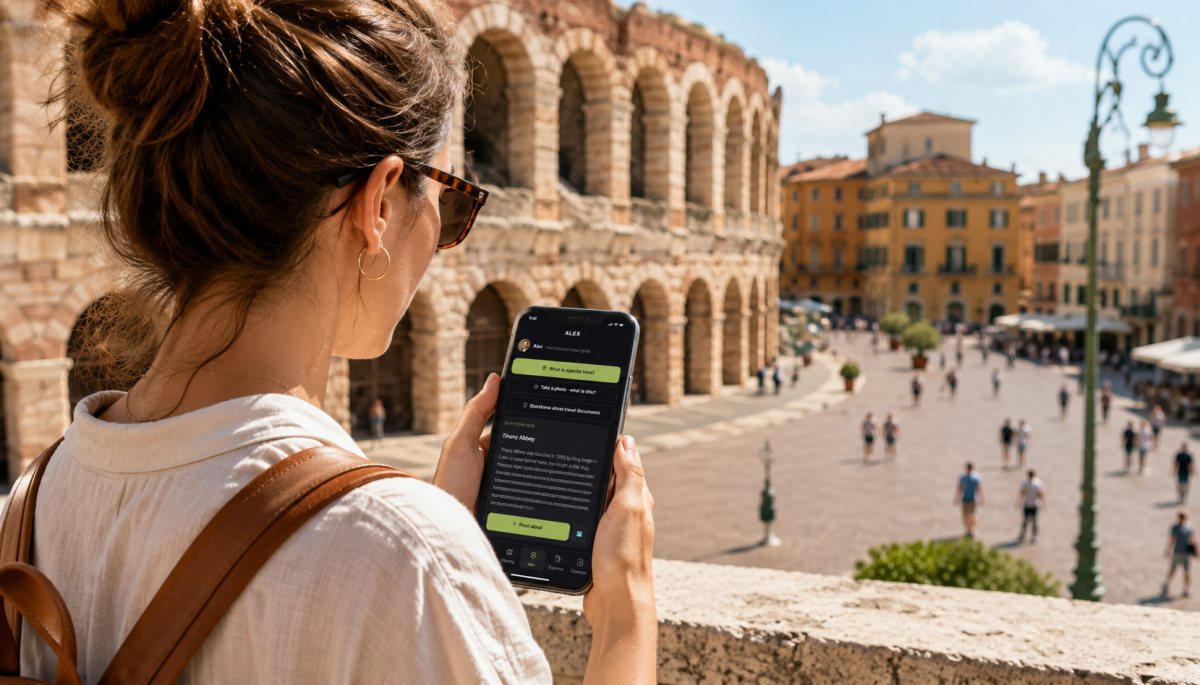
TravelAppBuilder (TAB) is the only app in this comparison that tells you something about the place where you are standing. Its built-in travel guide recognises where you are and tells you stories and historical facts about that place – even when you are offline.
Getting started is simple: upload your booking documents and receive one personal web app for that particular trip. No blank canvas: the app creates itself. It includes today’s day plan, your itinerary with hotels and transfers, the weather at the place where you are staying that night, currency information with a change-check, the country’s emergency numbers, a page explaining scams in your travel region, expense sharing with friends, and a guide that tells you where you are – also working offline.
No app store, no installation, just a link. €19 for your complete travel app, one-off, regardless of how many people are travelling.
When you do not need TAB: if you want to build a route yourself on a map, choose Wanderlog. If you want gate changes and delays, choose TripIt Pro. If you want a photo book afterwards, choose Polarsteps. If you have not booked anything yet, you can also enter your plans manually, although this is not recommended for now.
----
What can each travel app do, and what does it cost?
| TravelAppBuilder | Wanderlog | TripIt | Google Maps | Polarsteps | Lambus | Tripomatic | Mindtrip | |
|---|---|---|---|---|---|---|---|---|
| Type | travel companion | planner | companion | map | journal | planner | planner | AI planner |
| Dutch interface | yes | no | no | yes | yes | no | no | yes |
| Can be used without an app store | yes | yes | yes | yes | no | yes | no | no |
| Offline without a paid plan | yes | no | yes | yes | partly | no | no | unknown |
| Creates itself from your booking documents | yes | no | yes (email) | no | no | yes (email) | no | partly |
| Stories about where you are at that moment | yes | no | no | no | no | no | no | no |
| Share expenses within the group | yes | yes | no | no | no | yes | no | expenses |
| Build a route yourself on the map | no | yes | no | yes | no | yes | yes | yes |
| Flight status and delays | no | disputed | yes (Pro) | yes | no | yes (Pro) | yes (extra) | no |
| Travel journal afterwards | not yet | no | no | no | yes | partly | no | no |
| Price | €19 per trip, one-off | free + Pro approx. €30–60/year¹ | free + Pro €48.99/year | free | free + Plus €29.99/year | free + PRO €24.99/year | free + Premium €23.99/year | free |
¹ Wanderlog charges by region. The Dutch App Store lists several annual prices at the same time (€29.99 to €59.99), alongside €5.99 per month. Check your own price in the app rather than relying on the figure in a US review.
The bottom three rows are the areas where we lose out. They are included deliberately.
----
Which travel app is best for planning a trip yourself?
Wanderlog. Unlimited trips, real-time collaboration on a map and expense sharing included. If planning the trip yourself is the most enjoyable part, this is a good choice.
Where it falls short: the basic version is free, but exactly what you need while travelling is behind Pro – offline access, the AI assistant and Gmail import. The interface is English-only; the Dutch pages on its website are marketing pages, not a translated app. Reviewers report that the app becomes slow with large travel plans.
----
Which travel app is best for frequent flyers?
TripIt. Forward your booking confirmations and you get a complete itinerary in return – this works for free. Pro (€48.99 per year) adds real-time delay alerts, gate information and alternative flights.
Where it falls short: TripIt supports English, French, German, Japanese and Spanish – not Dutch. A Dutch-language confirmation from your travel agent therefore cannot be imported reliably.
----
Which free travel app is best for navigation?
Google Maps. Save places, use offline maps, access the best flight and hotel search engine, and use the app fully in Dutch.
Where it falls short: it is not a travel itinerary, nor is it becoming one. Google Trips was discontinued in 2019 and the travel overview in Google Travel was removed in 2023 – Google is therefore actively moving away from this direction. Saved places all use the same icon, you cannot filter or sort them, and there is no day-by-day structure. The Gemini assistant “Ask Maps” has been announced for the US and India; whether it will come here is unconfirmed.
----
Which app is best for documenting your trip afterwards?
Polarsteps, a Dutch product with 5.5 million users here, out of 20 million worldwide. It tracks your route via GPS and turns it into a shareable story or a printed travel book. Plus costs €8.99 per month or €29.99 per year.
Where it falls short: it does not plan or guide you. No booking storage, flight information, expense sharing or PDF export.
----
Which travel app is best for a group trip?
Lambus. The only one that combines collaborative planning and automatic expense splitting effectively. PRO costs €24.99 per year, €9.99 per individual trip or €99.99 for lifetime access.
Where it falls short: offline access is behind PRO. Lambus was acquired by Tourlane in July 2026, and Tourlane has not yet publicly decided what will happen to the consumer product. A lifetime purchase of €99.99 is therefore a gamble – stick to the per-trip price.
----
Which app plans your days visually on a map?
Tripomatic – and note: “Sygic Travel Maps” no longer exists. The app has been called Tripomatic since November 2024 and has a different publisher. Any comparison using the Sygic name is out of date.
Drag attractions onto a map and immediately see whether your day works logistically. Premium costs €23.99 per year or €34.99 as a one-off; the AI assistant costs an additional €22.99.
Where it falls short: the free version contains adverts and limits the number of trips, offline access is entirely behind the paywall, and the “guides” are a basic database rather than a written story. English only.
----
Can you have AI plan your trip?
Yes, but check everything specific. In an FBTO test of 1,500 Dutch people in July 2026, 46% received incorrect travel information. The best model scored 67.6% correct. Five out of six recommended the Wilhelmina Tower in Valkenburg, which collapsed in March 2025. Five out of six did not know that Bulgaria adopted the euro on 1 January 2026. And around a quarter of users discovered the mistake only during the trip.
A test for Forbes produced an invented restaurant and a train journey to the Jungfraujoch that was estimated to cost hundreds of dollars too little. The BBC described tourists being sent to a non-existent canyon in Peru, at 4,000 metres without reception.
Mindtrip is free, has been available in Dutch since July 2026 and actually books flights in the app. Layla costs $49.99 per year and has no Dutch interface. Use them for inspiration, not for opening hours, prices or checking whether a place exists.
----
How much does a travel app cost per trip?
For someone who travels once a year:
| App | Cost for that one trip |
|---|---|
| TripIt Pro | €48.99 |
| Layla Premium | approx. €46 |
| Wanderlog Pro | approx. €30–60 |
| Polarsteps Plus (annual) | €29.99 |
| Paper guidebook | €12.50–32 |
| TravelAppBuilder | €19 |
| VoiceMap, two walks | approx. €10–18 |
| Lambus PRO per trip | €9.99 |
| Google Maps, Mindtrip, TripAdvisor | €0 |
Pay attention to what you are buying. A subscription continues for eleven months while you are at home, and the free versions stop precisely where your trip begins: with Wanderlog, Lambus and Tripomatic, offline use is behind the paywall. TAB costs €19 and is a one-off purchase for this trip, with offline access included.
----
Try TravelAppBuilder without paying
Have your travel app created and view day 1 for free before you decide – including the weather, currency and the actual address of your first overnight stay. Travel agency? Request your three free trial apps, with your own name and logo included.
→ Create your travel app · → See what is included in the app